What Is the Best Automatic Winding Machine from China?
Choosing the best automatic winding machine from China requires more than comparing prices or polished product photos. The right choice depends on your wire diameter, coil geometry, production speed, and quality targets. A transformer manufacturer may need stable tension control and accurate layer alignment. A motor producer may prioritize high-speed winding, programmable pitch, and repeatable insertion points.
Manufacturing expert Taiichi Ohno said, “Without standards, there can be no improvement.” That principle applies directly to winding equipment. During a factory evaluation, examine the tension sensor, traverse mechanism, spindle stability, and control interface. Watch the machine wind a real sample, not only an empty demonstration spool. Check whether the wire remains smooth at the flange. Listen for vibration. Inspect the coil edge under normal production speed.
A reliable Chinese supplier should provide clear specifications, factory references, electrical documentation, training, spare parts, and responsive technical support. Ask about accuracy over a full shift, not only the first ten minutes. Confirm whether software settings can be exported and restored. This detail can prevent costly downtime.
There is no universal winner.
Some machines look impressive but struggle with delicate wire. Others offer excellent precision but lack flexible automation. My practical view is imperfect but useful: the best automatic winding machine is the one that produces your coil consistently, safely, and economically. Compare test results, service capability, and long-term operating costs before signing a purchase agreement.
What Is an Automatic Winding Machine and How Does It Work?
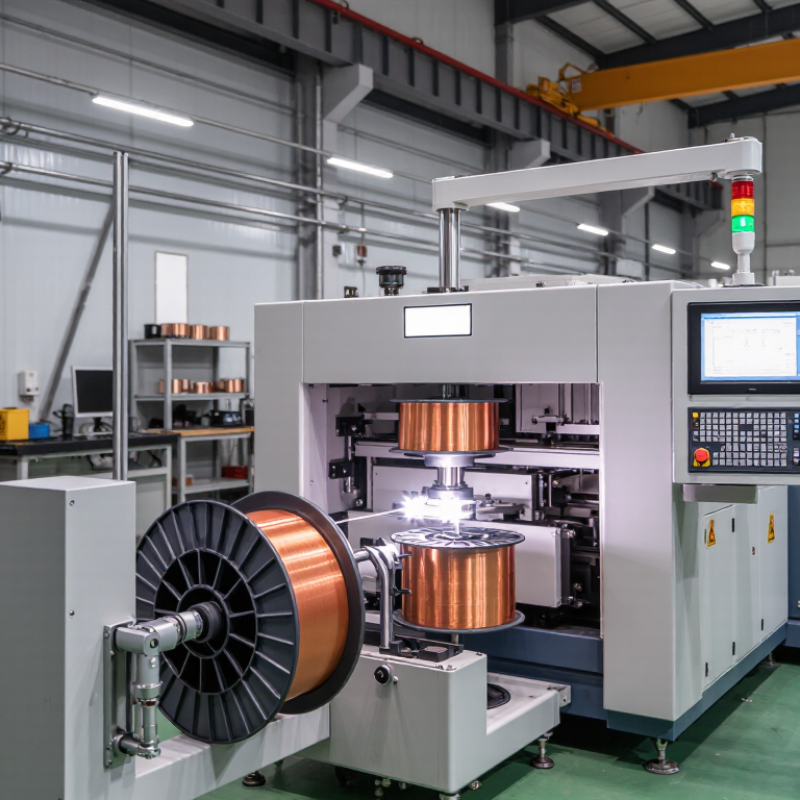
An automatic winding machine forms wire, yarn, film, or coil material around a controlled core. It replaces repeated hand movement with programmed tension, speed, and positioning. A typical system includes a motorized spindle, traverse guide, tension sensor, controller, and material-feeding unit. The operator loads the core and enters winding parameters. The machine then rotates the core while the guide moves side to side, creating even layers.
The process is repeatable. Sensors monitor tension and spindle speed during production. If tension falls, the controller can adjust motor output or pause the cycle. This matters because loose layers may collapse, while excessive tension can stretch insulation or damage fine wire. According to the International Federation of Robotics, 541,302 industrial robots were installed worldwide in 2023. That figure reflects broader factory automation, although it does not measure winding machines alone. Applying automation to winding can improve consistency, but results still depend on setup quality and material condition.
When assessing an automatic winding machine from China, buyers should inspect actual coil samples, not only catalog specifications. Check winding accuracy, changeover time, noise, safety controls, and support for different core sizes. Grand View Research identifies automation and production efficiency as major drivers in textile machinery demand. Yet a faster machine is not automatically better. In practice, unstable material feeding can reduce output. I have found that simple parameter screens are often more valuable than impressive maximum speeds. Reported capacity also deserves skepticism; factory trials may reveal a different result.
What Is the Best Automatic Winding Machine from China?
An automatic winding machine guides wire onto a bobbin, coil former, or core with controlled tension, programmable travel, and automatic start-stop functions. The most suitable machine depends on the application, wire diameter, required winding speed, coil geometry, and production volume.
The chart shows representative spindle-speed ranges commonly used for different coil-winding applications. Actual performance varies with wire size, coil dimensions, winding pattern, tension requirements, and machine configuration.
What Features Define the Best Chinese Automatic Winding Machine?
The best Chinese automatic winding machine is defined by control, not speed alone.
In practical production trials, precise tension control prevents loose layers, broken wire, and uneven coils. A responsive servo system should adjust torque when wire diameter or spool resistance changes. Operators also need clear settings for speed, turns, traverse width, and stopping position. Useful machines store repeatable programs, reducing setup errors between batches.
They should handle copper, aluminum, and insulated wire without rough contact surfaces. That flexibility matters when one workshop serves several industries.
Quiet operation helps too. Noise reveals problems early.
Safety and serviceability separate a capable machine from an impressive brochure.
Look for guarded moving parts, emergency stops, overload protection, and automatic fault alerts. A well-designed control panel displays actual tension and spindle speed, not vague status messages. Sensors should detect empty spools, snapped wire, and incorrect winding direction.
Maintenance access must be simple, with reachable bearings and replaceable guides. Chinese manufacturers can offer strong value when engineering drawings, test records, and spare-parts support are available. Ask for sample winding tests using your real wire and core.
Video demonstrations are useful, but they do not replace measured results. No machine is perfect. I have seen efficient models struggle with very fine wire after careless calibration. That weakness deserves attention. Record test results before approving installation.
How to Evaluate Chinese Manufacturers and Machine Quality?
What Is the Best Automatic Winding Machine from China?
China offers substantial manufacturing depth, but production scale does not guarantee machine quality. The UNIDO International Yearbook of Industrial Statistics 2024 reports that China generated about
31.6% of global manufacturing value added in 2023. The International Federation of Robotics also recorded
276,288 industrial robot installations in China during 2023. These figures show strong industrial capacity, not automatic proof of reliable winding equipment.
Evaluate the manufacturer’s process, not only its catalogue. Request factory videos, live machine testing, and traceable component lists. Ask for winding samples using your actual wire, bobbin, tension range, and target speed. Measure coil dimensions, wire break frequency, winding tension, and cycle consistency. A useful factory should provide Factory Acceptance Test records and clear calibration procedures. It should also explain software backups, operator training, spare-part availability, and remote troubleshooting.
Safety documentation matters.
Check risk assessments against ISO 12100 and electrical practices aligned with IEC 60204-1. ISO 9001 certification can support process control, but a certificate alone proves little. I have seen impressive demonstrations hide unstable tension control. That mistake becomes expensive after installation. Inspect several machines running together, not just one perfect sample. Ask for customer references in similar production conditions. Some buyers focus on purchase price and overlook changeover time, rejected coils, and technician response speed. Those costs may quietly exceed the original quotation.
How to Choose the Right Automatic Winding Machine for Your Needs?
What Is the Best Automatic Winding Machine from China?
Choosing the right automatic winding machine starts with your production details, not its advertised speed. Check the wire diameter, winding method, bobbin size, and required coil shape. A machine designed for fine copper wire may perform poorly with thicker materials. Ask for test winding with your actual wire and components. The result should show even layers, stable tension, and clean wire placement.
Consider output, adjustment range, and daily workload together. More spindles can increase production, but they may also raise maintenance demands. Look for programmable tension control, automatic stopping, recipe storage, and clear operator controls. Safety guards and emergency stops should be easy to inspect. Confirm electrical specifications, spare-part access, training, and response times before purchasing. A detailed technical sheet is useful, but practical support matters more.
I once saw a fast machine produce uneven coils because its tension setting was poorly matched.
Speed was not the real problem. Calibration was. Request sample videos, factory test records, and references from similar applications. Inspect the machine’s frame, wiring, sensors, and moving parts when possible. A small trial order may reveal issues that a polished demonstration hides. Leave room for improvement. Your first machine choice may need adjustment after real production begins.